Original desk analysis of cited primary-source reports. No first-hand inspection or transaction participation is claimed. Updated September 25 to distinguish CGC’s separate Incorrect Illustrator sale report; the original Marketing Variation report remains unchanged.
WHY IT MATTERS
Marketing Variation is the essential identifier. The $3.3m figure is a CGC-reported private sale from August 2026, with closing day and fees undisclosed.
Event date: . This article’s publication date is shown separately above.
A small design difference carries the identity
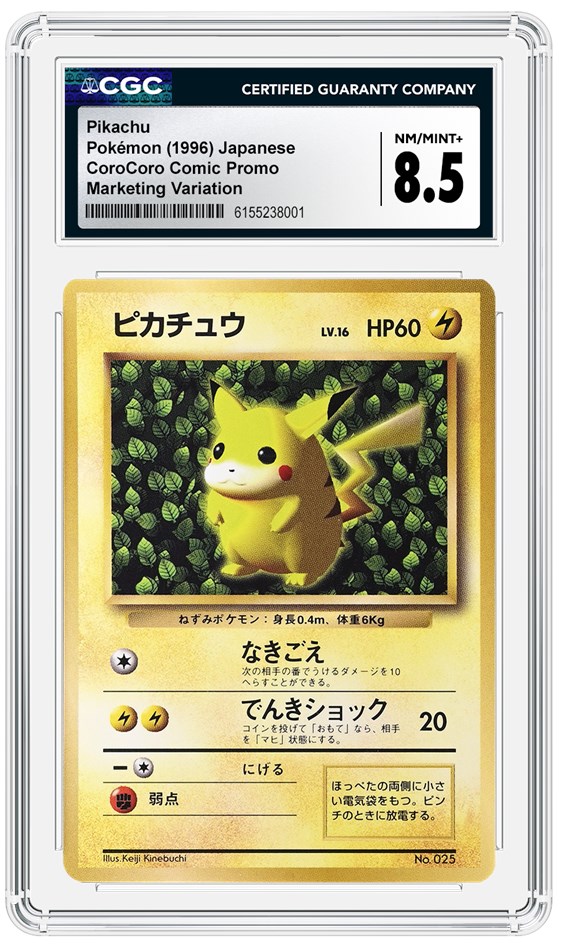
CGC announced on August 21, 2026 that a Japanese CoroCoro Comics Pikachu Glossy Marketing Variation, dated 1996 and graded CGC 8.5, had sold privately for $3.3 million during August. The report associates the example with the Card Bound Collection. It does not disclose the precise closing day or a private fee schedule. Those limits belong with the headline rather than being left for a reader to discover later.
The most useful part of the story for an exact-card collector is the variant identification. According to CGC’s account, this version has two leaves below Pikachu’s left foot, different positioning within the artwork and the correct Keiji Kinebuchi illustrator credit. The familiar nickname “Ivy Pikachu” is therefore not sufficient to identify the sold object. A tiny visible feature can matter more to identification than the large character name that dominates a listing.
The separate $1.3 million report concerns Incorrect Illustrator
CGC’s September 2 announcement describes another August private sale: a Japanese 1996 CoroCoro Comics Pikachu Glossy — Incorrect Illustrator, graded CGC Gem Mint 10, reportedly sold for $1.3 million. It has the mistaken Ken Sugimori credit and lacks the leaves below Pikachu’s foot. The source gives no closing day or fee terms.
Keep this result in a separate row from the $3.3 million Marketing Variation. A shared nickname does not make them comparable copies, and their different grades cannot explain the price difference on their own. Both amounts remain attributed private-sale reports, rather than independently verified settlements.
Start with a variant map, not an asking price
When several related versions share a recognizable image, begin by mapping the documented distinctions. Record the title used by the relevant catalog, the finish, the illustrator credit and the physical details that separate the versions. Keep the front and reverse reference images attached to each entry. A comparison made this way is reproducible; a comparison based only on whether two cards look broadly alike is not.
This does not mean an enthusiast should attempt high-stakes authentication from a few pixels. The purpose of a variant map is to identify the questions that need answering. If a seller claims a special version, the photographs and supporting certification should resolve those questions. If they do not, the identification remains incomplete regardless of how confidently the title is written. A major sale increases the incentive for imprecise naming, so it should also increase the reader’s attention to the exact designation.
Marketing history is a separate claim
CGC describes the variant as associated with early promotional material before the Pokémon TCG’s release. That is a historical identification supplied by the grader’s research, and it should remain attributed. Recognizing a pictured detail is not the same as independently establishing how a physical card was produced, distributed or preserved.
For a collector studying early development material, the interesting work lies in connecting objects to contemporary evidence. A dated magazine, an original promotional image and a later certification report can each support different parts of the account. Their roles should not be blended into one sweeping claim. A photograph can establish that a design was shown publicly; it does not by itself tell us how many physical examples were made or who received them. Keeping those questions distinct produces a stronger history and a more useful guide to unusual cards.
The lower grade is not a contradiction
A CGC 8.5 can appear beside a multimillion-dollar reported price because the grade and the edition’s identity measure different things. The numerical assessment does not tell a collector how many examples of a particular developmental variant are available or how strongly a buyer values its historical role. Equally, rarity does not make the card’s condition irrelevant.
For someone comparing early promotional cards, the practical approach is to inspect condition within the correct variant category. First establish what the card is; then consider its grade, presentation and any disclosed issues. Reversing that order can lead to meaningless comparisons between a higher-grade ordinary version and a lower-grade exceptional version. There is no universal formula that converts those differences into a fair price. The guide’s job is to make the trade-offs visible, leaving the collecting decision grounded in an identified object and a real budget.
Private-sale evidence should remain attributed
This result is reported by the company that certified the card. That gives the announcement a direct relationship to the object, but RippingPatrol has not reviewed the transaction’s settlement documents. The public account supports a grader-reported private sale. It should not be dressed up as an open auction with a visible competition history.
This is also why the amount should not be used to calculate a broad early-Pokémon trend. One exceptional variant, one reported agreement and limited disclosed terms do not establish what happened across other cards. A trend claim needs a defined sample and comparable observations. The announcement can still justify a substantive article because it draws attention to an identifiable collecting category and a documented milestone. Useful reporting does not require every important object to become a market-wide indicator.
What to save in the collector record
Save the exact Marketing Variation wording, the CGC designation, the source announcement and the month-level event date. Retain a note that adjacent glossy and incorrect-illustrator versions should not inherit this sale. If referring to CGC’s population observations or record language, attach the August 2026 observation date rather than treating the statement as timeless.
The broader lesson is that collector expertise often consists of noticing which tiny differences are meaningful and knowing where that knowledge came from. The two leaves are memorable, but the evidence surrounding them is what makes the identification useful. A well-built card publication should let a reader move from the striking price to the exact object, then to the source that explains it. That path creates understanding without suggesting that every similar-looking Pikachu is a hidden multimillion-dollar discovery.