Original desk analysis of cited primary-source reports. No first-hand inspection or transaction participation is claimed.
WHY IT MATTERS
May 27, 2021 is the announcement date. Keep the private-sale attribution and undisclosed fee basis attached to the $3.75m figure.
Sale announced ; the private closing date was not reported.
The announcement and the transaction are different dates
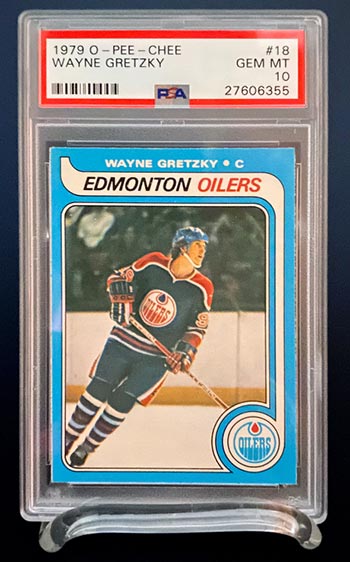
On May 27, 2021, Heritage announced that it had brokered a $3.75 million private sale of a 1979 O-Pee-Chee Wayne Gretzky rookie card graded PSA GEM MT 10. The buyer and seller were not named in its public report. The announcement date is verifiable; the precise closing date of the private agreement is not supplied. A careful sales registry should say so rather than treating the release date as a witnessed transaction timestamp.
This distinction is useful well beyond celebrated cards. Private deals often become public only after the parties are ready to discuss them. A story can therefore be fresh reporting about an earlier event. Keeping event date, announcement date and editorial publication date separate prevents a historical sale from being presented as this week’s new market movement. It also prevents an apparently exact timeline from concealing gaps in what the source actually disclosed.
O-Pee-Chee belongs in the title
The card’s issue is part of the evidence. A familiar player image does not make different manufacturers’ versions interchangeable, and a general search for a “Gretzky rookie” can surface objects with materially different identities. Before using a sale as a comp, retain O-Pee-Chee, the year, the card identification and the exact grade.
This sounds elementary until a spreadsheet or social-media post shortens every row to the player’s name. Then a premium result can migrate into an unrelated listing with almost no visible warning. For a collector building an early-career player collection, the better approach is to map the issues first. Decide whether the aim is one representative card, a particular national release or a broader comparison of contemporary products. Once that scope is explicit, prices can be investigated within the intended group rather than used to define the group after the fact.
A broker is a relevant source with a defined role
Heritage was not merely repeating an anonymous internet claim; it said it brokered the transaction. That is a meaningful relationship to the event and a reason to include the report in a documented history. It still does not give the reader access to the contract, the payment trail or every term negotiated between the parties.
The right editorial language can hold both facts at once. Describe the transaction as a Heritage-reported, Heritage-brokered private sale. Do not imply that RippingPatrol examined settlement documents or watched the exchange. Attribution is not a weak substitute for reporting; it is the precise description of the evidence available. A reader can then decide how much weight to place on the result and which additional details would matter for the decision they are trying to make.
A tiny elite sample cannot represent the whole issue
Heritage’s announcement described the card as one of two PSA 10 examples known then. That historical observation belongs to the 2021 source; it is not a live population check. More importantly, a transaction at an extreme condition tier cannot alone establish what a lower-grade copy should cost or how readily it might sell.
Collectors at other condition levels face different choices and may value different features. A well-presenting example with visible wear can fulfill a collection’s purpose without resembling the auction headline. The relevant research is the market for that intended example, including condition, authenticity and actual comparable transactions. Using the top of a graded population as a multiplier for every other copy replaces evidence with a story. The headline can motivate learning, but it should not become the only input into an ordinary purchase.
Why the sale remains worth recording
A durable hobby history needs private transactions as well as auctions, provided their evidence is labeled consistently. This Gretzky sale contributes an identified issue, an exact reported grade, a named broker and a published consideration. Those facts are substantial even though buyer identity, closing day and fee detail remain undisclosed.
The result’s lasting value to readers is partly the collecting object and partly the model of how to report it. Preserve what is known, identify the source’s role and leave unanswered fields unanswered. Then connect the story to an edition guide that helps readers recognize what they are actually considering. A famous private sale should increase the reader’s understanding of a card, not pressure them to treat every related listing as an opportunity that must be acted on immediately.