Start with a reason, not a superlative
Charizard is a broad collecting subject. A person drawn to the original character may want a chronological story; another may care about a particular illustrator, a modern mechanic or a favorite scene. A useful collection does not need to reproduce someone else’s ranking. Give the project a sentence that describes what you want to see when you open the binder.
One approach is to select a single card from each personally meaningful era. Another is to build an evolution-line page. Both create boundaries that a generic instruction to buy the best Charizard cannot provide.
Read the 151 example carefully
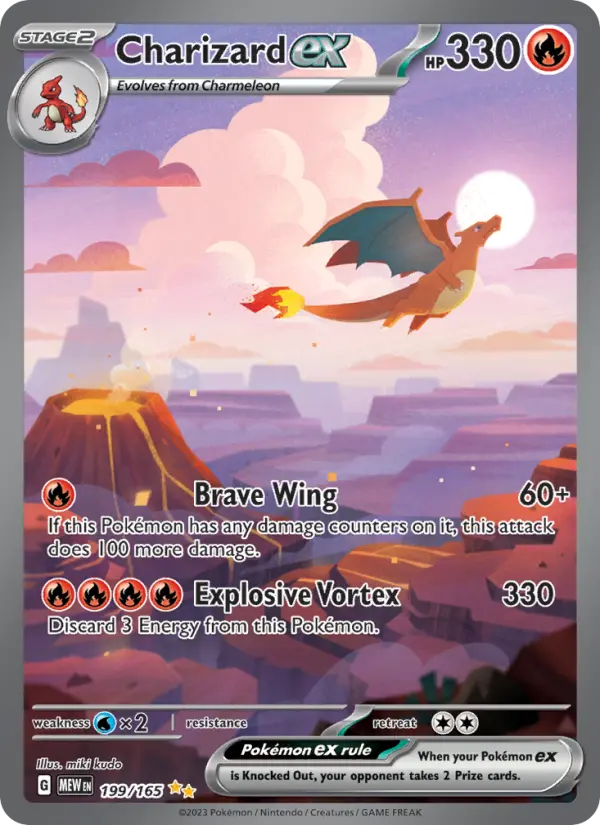
English Scarlet & Violet—151 released on September 22, 2023. Charizard ex 199/165 is its special illustration rare print, a different card entry from the regular ex and the ultra rare treatment. The illustration provides a reason to study the set’s visual storytelling, rather than use the character name as a shorthand for rarity or value.
A collector interested in the complete evolution sequence should identify the matching Charmander and Charmeleon illustrations individually. A page containing three familiar names is a character grouping; a page using a specific set’s connected visual approach is a more defined project.
Names are not valuation keys
Charizard ex can describe several products and treatments. The English 151 card numbered 199/165 is not the Japanese 201/165 version, and neither should inherit a price from a vaguely labeled search result. Record set, language, number and finish before looking at sale evidence. Then separate raw copies from graded examples.
Condition also belongs to the individual item. Front-and-back photographs, edges, corners and surface matter more than a catalog image. For a slab, match the certification and label to the pictured holder. These steps establish what is being offered; they do not predict its future price.
Build the 151 evolution triptych
A specific three-card project uses English Charmander 168/165, Charmeleon 169/165 and Charizard ex 199/165. The first two are illustration rares; the Charizard is a special illustration rare. They belong together as an evolution sequence, even though the rarity names differ. Numbering the want list before shopping prevents the ordinary Charmander or another illustrated Charizard from being mistaken for a missing member of this group.
A three-pocket row gives the stages equal visual space. You could build that row slowly, leaving labeled placeholders rather than repeatedly substituting unrelated copies. If you enjoy opening 151 packs, record those purchases separately from the cost of finishing the row: an enjoyable opening that adds no missing card is still an opening experience, not progress on this particular project.
One set, three distinct Charizard choices
The English 151 checklist lists Charizard ex at 006, 183 and 199. These are different numbered presentations within the same expansion. A collector who wants to study the character’s treatment can make those three entries the whole project, comparing how the same name is presented across the regular ex, ultra rare and special illustration rare cards.
That is a different aim from collecting the Charmander-to-Charizard sequence. Sketch both layouts before committing to one. The evolution row emphasizes changing characters and a visual narrative; the three-Charizard row emphasizes changes in treatment. Neither requires adding every Charizard from another product. Keep the intended card number in saved searches because broad titles such as “151 Charizard full art” can blur the distinction.
Use eras to tell a personal history
An era collection works best when its milestones are personal and explicit. One card could represent the period when you first played, another the time you returned to collecting, and a third a set you opened with someone else. Record the reason beside the expansion and print identity. That produces a history you can explain without borrowing a list of the most expensive cards.
Choose whether the cards must have been owned during those periods or whether later acquisitions may represent them. Those are both coherent collections, but they tell different stories. Set a maximum number of chapters before shopping. Adding a new chapter should require a meaningful reason, rather than the discovery of yet another product bearing the character.
Read condition through the intended display
For a binder sequence, the important question may be whether surface wear interrupts the artwork when the page is viewed normally. For a graded display, consistent holder dimensions and legible labels might matter more. Decide that preference before comparing a raw copy with a premium graded example; otherwise it is easy to pay for a feature that the final presentation will hide.
Request images that show the actual card at more than one angle. A straight-on photo can conceal a scratch in a reflective area, while sleeve glare can resemble damage. Check the back as carefully as the front and distinguish wear on the holder from wear on the card. These observations help evaluate the offered specimen; they do not establish an ungraded card’s eventual grade.
Turn an online chase into an exact target
If a ripping platform advertises Charizard, identify the actual print in its pool before treating it as a route to your collection. A generic character image, a graded-card tier and a named 151 special illustration rare are three different descriptions. Confirm the number, language and grade of the potential pull, then establish whether the pictured card is current inventory or merely an example.
For a card you already own digitally in a physical-card vault, include shipping and any redemption charge in the decision to place it in the binder. Selling it back for platform credit may be convenient for further openings, but that leaves the physical collection unchanged. Choose the action that serves the project you planned, rather than allowing the next reveal to redefine it.
Let one card carry the story
A focused display can explain why one Charizard matters to its owner: the set, the composition, the artist or the place it holds beside earlier cards. That story is more durable than a changing price screenshot. Keep a short collection note with the acquisition date and exact identity. If a different print fits the theme better later, revise the want list rather than treating the first plan as an obligation to accumulate every version.