The set in context
English Evolving Skies released on August 27, 2021, as part of the Sword & Shield series. The catalog records 203 cards in the main numbering and 237 numbered entries including cards beyond that denominator. Those figures describe the catalog, not every possible finish, promotional addition or definition of a master set.
That distinction is useful before buying a binder or making a budget. A numbered set, a set including reverse-holo versions and a personal selection of illustrated favorites are different projects. Each can be complete on its own terms when its boundaries are clear.
Let the artwork guide the route
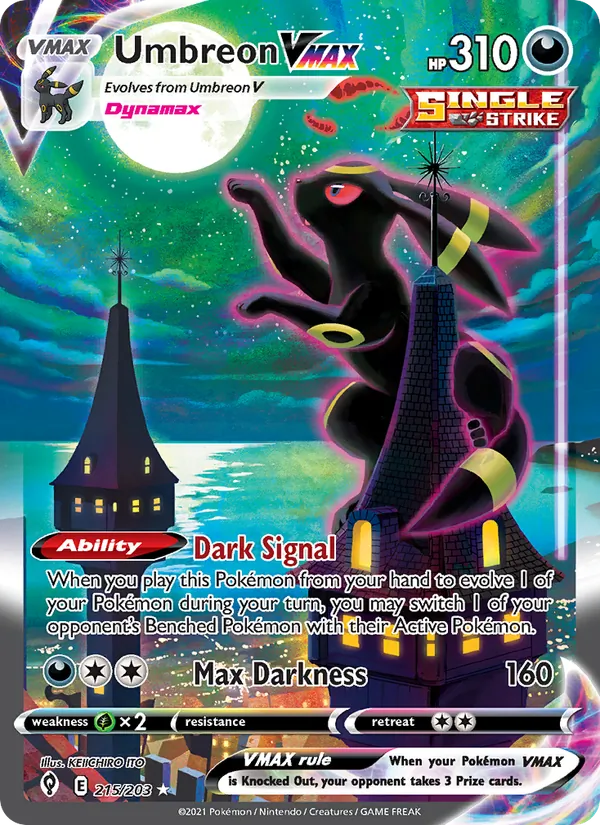
Umbreon VMAX 215/203 provides a recognizable focal point, with its moonlit scene and full-card composition. It can anchor an Umbreon page, an Eeveelution theme or a modern alternate-art collection. It need not turn every other Evolving Skies card into background material. Looking through the complete catalog can reveal a visual direction that fits your own preferences.
The set’s number is part of the identity: other Umbreon VMAX prints appear within Evolving Skies. Use the artwork and 215/203 together when searching. An English print and a related Japanese print belong in separate catalog records.
Define completion before opening
A sealed booster is a random product, while a missing binder slot is a specific target. Opening packs may be part of the enjoyment, but it cannot promise efficient progress toward the last few cards. Keep the spending devoted to the opening experience separate from the budget for selected singles.
Also distinguish an original manufacturer pack from a platform’s Evolving Skies-themed mystery product. A themed name might describe a pool of individually sourced cards rather than sealed boosters. The product description, current inventory and rules establish what is actually being purchased.
A checklist needs a finish column
Pokémon’s downloadable checklist distinguishes standard, foil and parallel-set checkboxes. Treat those as separate collection states where they apply. Checking a card number once can mean you own the design; it does not necessarily mean you own every available finish. Conversely, not every entry has every finish, so a spreadsheet that automatically creates three targets for each number will manufacture missing cards.
Start with one row per numbered entry and add only the applicable finish fields. Keep the cards above 203 in the same numbered collection, then put any additional promotional project on its own sheet. That makes progress meaningful: “numbered entries owned” and “finish variants owned” answer different questions and should not be combined into one unexplained completion percentage.
Look beyond the Eeveelution chapter
The main checklist offers several smaller sequences. Hoppip 002, Skiploom 003 and Jumpluff 004 make a three-stage group. Bagon 107, Shelgon 108 and Salamence 109 provide another. Rayquaza V 110 and Rayquaza VMAX 111 create a two-card mechanic pairing. These are specific alternatives to a project built entirely around one alternate-art target.
A small binder could dedicate a row to each evolution line and a separate row to a chosen V/VMAX pair. Select the layout first, then decide which finishes you prefer. The resulting collection has a visible structure even if you never pursue all 237 catalog entries. It also gives ordinary cards a purpose beyond being counted as the leftovers from a pack.
Understand the Build & Battle connection
The publisher’s launch coverage describes an Evolving Skies Build & Battle Box with four expansion boosters and an Evolution pack containing one of four foil promos: Flaaffy, Galarian Articuno, Galarian Zapdos or Galarian Moltres. That associated product creates a natural optional side collection for someone interested in the release’s wider presentation.
Keep its promotional card identities separate from similarly named cards in the expansion. A familiar Pokémon name does not establish that the promo and the set card are the same collectible. If the goal is just the numbered set, those promos can remain outside the project. If the goal includes the launch experience, label the additional group clearly rather than silently increasing the definition of completion.
Plan the binder around the chosen definition
One copy of each of 237 numbered entries occupies 237 pockets: at least 27 nine-pocket sides, or 20 twelve-pocket sides, before adding any other finishes. This is simple layout arithmetic, not a specification for a particular binder. Space for variants, title cards and future rearrangement changes the practical requirement.
Decide whether parallel copies sit beside their ordinary counterparts or in a separate sequence. Side-by-side pairs make finish differences easy to inspect, while separate sequences preserve numerical order more compactly. Try a few completed groups in the intended layout before placing hundreds of placeholders. Changing the organization early is much easier than dismantling a nearly full binder because its final section no longer fits.
Measure the last stage by missing identities
Once a collection is mostly filled, count the specific gaps and their intended finishes before opening more product. Ten empty spaces may represent ten ordinary entries, several duplicate finishes or a handful of very particular illustrated cards. Those are different completion problems, even if a progress bar gives them the same percentage.
A dated want list makes trading and buying singles more precise. Mark copies that are already secured but still in transit so they do not become accidental repeat purchases. Keep condition upgrades on a second list: replacing an owned card with a preferred specimen improves the collection, but it should not make a completed numbered slot appear missing again.
Keep a record that survives changing prices
For every selected card, record the number, language, finish and condition, plus a source-linked image for identification. Add actual-item photographs for valuable specimens and certification details for graded copies. Values, when recorded, need a date and a comparable basis. A whole-set guide should not replace those separate identities with one generic price.
The most useful finished collection has an understandable purpose. Whether that purpose is a compact Eeveelution display or a larger set binder, write down its boundaries so future releases and changing attention do not continually move the finish line.